FloraNew's Proprietary Blend, Explained: What a 695mg Label Does (and Doesn't) Tell You
FloraNew's sales page states, in the hero section and again in the "Inside Every Capsule" cards, that the product is a "695mg Proprietary Cleanse Blend" of eight named ingredients, plus a separately stated "1.5 Billion CFUs" of Lactobacillus acidophilus. If you have ever wondered why a supplement label can print a big headline number like 695mg without telling you how much of any single ingredient is actually in the capsule, the answer is a labeling category called a proprietary blend — and it is worth understanding exactly what that format legally requires and what it leaves out, before you decide what the number means to you.
What does FloraNew's 695mg blend label actually tell you?
It tells you the combined weight of the named ingredients (695mg) and, separately, a CFU count for one of them (1.5 billion for Lactobacillus acidophilus). Under FDA labeling rules, a proprietary blend does not have to state how much of the 695mg is oat bran versus psyllium versus any other listed ingredient, so those individual amounts are simply not published anywhere we could find. We also could not locate an actual printed Supplement Facts panel on the sales page — only marketing text and ingredient cards, which is a separate and important gap on top of the blend format itself.
How a "proprietary blend" is allowed to work on a US label
Dietary supplements sold in the United States are regulated under the Dietary Supplement Health and Education Act (DSHEA) and FDA's Supplement Facts labeling rules. Those rules give manufacturers a specific option: instead of listing every ingredient with its own individual amount and, where one exists, its percent Daily Value, a company can group several ingredients together under a single blend name, print the blend's total weight, and list the ingredients underneath in descending order by predominance (that is, the ingredient present in the largest amount is supposed to be listed first, then the next largest, and so on).
That format is legal. It exists because some manufacturers consider their exact ratios a trade secret worth protecting from competitors. But the trade-off for the reader is real: once several ingredients share one combined weight, you cannot back-calculate how much of any single one is in your dose. A blend that is "mostly the first ingredient and a pinch of the rest" and a blend that is "an even split of all eight" can print an identical 695mg headline number and an identical ingredient list, and nothing on that label distinguishes the two.
This is different from an ingredient with its own individually printed amount — for example, "Vitamin C — 500mg" tells you exactly what you are getting. A line inside a proprietary blend does not.
Applying that to FloraNew's own page, ingredient by ingredient
Here is what the current sales page prints, in the order it prints it, and what it leaves unstated. FloraNew's hero copy and ingredient cards describe the product as a 695mg Proprietary Cleanse Blend made up of:
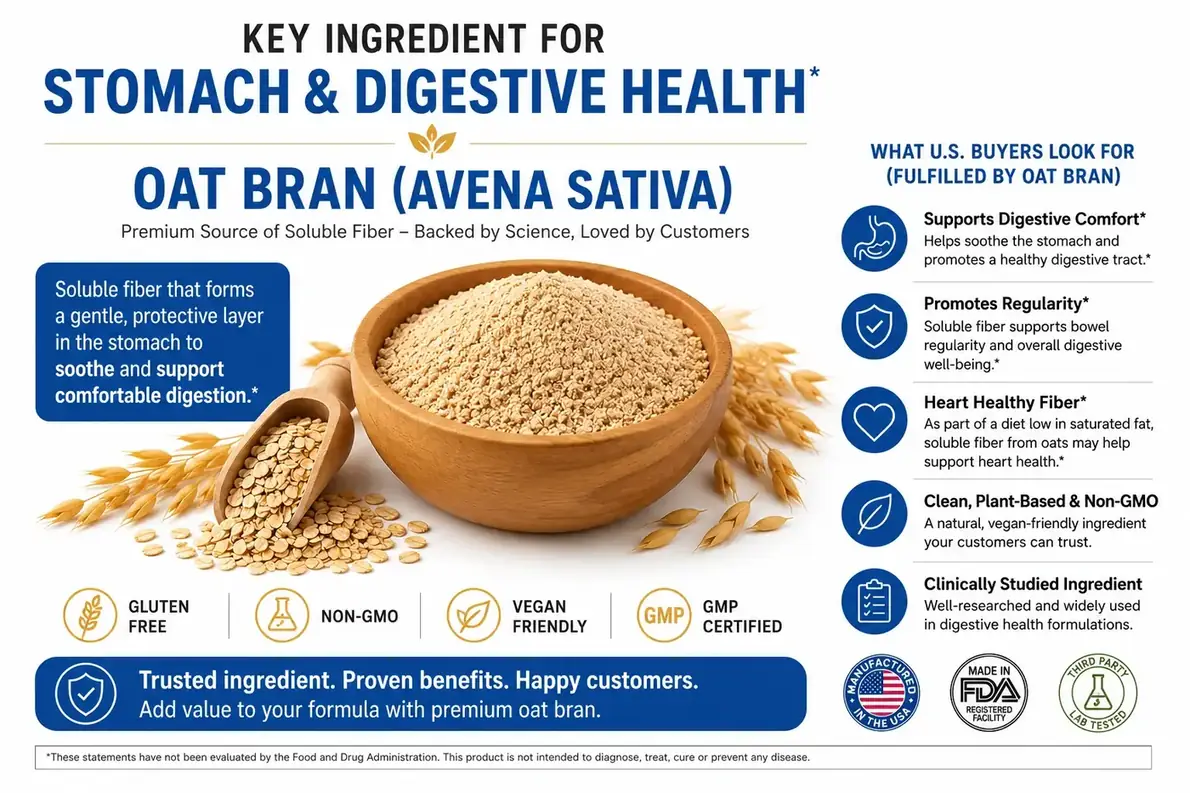
- Oat Bran Powder (Avena sativa)
- Flax Seed Powder (Linum usitatissimum)
- Psyllium Husk Powder (Plantago ovata)
- Apple Pectin Powder (Malus spp.)
- Glucomannan Powder (Amorphophallus konjac)
- Black Walnut Hull (Juglans nigra)
- Plum Fruit (Prunus domestica)
- Lactobacillus acidophilus (1.5 Billion CFUs)
Every one of the first seven ingredients is marked on the page as part of the "Proprietary Blend," with no individual milligram amount and no percent Daily Value next to any of them. The eighth line, Lactobacillus acidophilus, is the only ingredient given its own number at all — a CFU (colony-forming unit) count rather than a weight — and the page never states whether that 1.5 billion CFU figure sits inside the 695mg total or is counted on top of it. Both readings are plausible from the wording alone, and we have not found anything else on the page that settles it. That is worth sitting with for a moment: the single most specific-sounding number on the whole ingredient panel (1.5 billion) still has an unanswered question attached to it.
We also looked for whether the printed order (oat bran first, Lactobacillus last) is confirmed to reflect descending weight, as FDA format generally expects. The page does not say this explicitly anywhere we found; we only know the order in which the cards are displayed, which is not the same as a manufacturer explicitly certifying that order as weight-descending.
No Supplement Facts panel found — the bigger gap
A proprietary blend line is normally just one row on a full Supplement Facts panel, which would also show serving size, servings per container, other ingredients (capsule shell, fillers, anti-caking agents) and any %DV figures that do apply. On FloraNew's current about/sales page, we could not find an actual photographed or graphically reproduced Supplement Facts panel at all — only the marketing hero text and the ingredient cards described above. The page's own FAQ section refers to a "full ingredient list (available on the supplement facts label)," which implies a label exists somewhere, but no such panel image appears on the page itself.
That means several ordinary label questions go unanswered on the page as published: what the capsule shell is made from, whether any allergens are present, and what the exact serving size and servings-per-container line would say verbatim. We can infer that a bottle holds 30 capsules and that the FAQ recommends one capsule daily (which would imply 30 servings per bottle), but that is an inference from marketing copy, not a quote of a printed serving-size line.
A second ingredient list on the same page, and why it matters
Complicating things further, the same sales page includes a separate decorative graphic (captioned only with alt text reading "ingredients") that names six ingredients: chicory root, Jerusalem artichoke (inulin), aloe vera, slippery elm bark, psyllium husk, and peppermint leaf. Only psyllium husk appears on both this image and the text-based eight-ingredient list above. The other five names on the image (chicory root, Jerusalem artichoke/inulin, aloe vera, slippery elm bark, peppermint leaf) do not appear anywhere in the page's text-based ingredient description, and five of the eight text-listed ingredients (oat bran, flax seed, apple pectin, glucomannan, black walnut hull, plum fruit, and the Lactobacillus acidophilus) do not appear in the image at all.
This image is not labeled as a Supplement Facts panel, carries no amounts, and does not resolve which ingredient list is the accurate one. We are not going to guess which is correct, and we would encourage you not to either. If exact formulation matters to your decision, the honest next step is contacting the seller directly and asking them to send the actual Supplement Facts panel before you buy, rather than relying on either graphic.
A perception gap that goes beyond amounts
It is also worth separating two different problems that proprietary blends create. The first is the one covered above: you cannot see individual amounts. The second, more subtle problem is what one recent academic framework calls an "ingredient-interpretation gap" — where a raw botanical powder is presented among the active ingredients in a form that gives a reader no real way to judge whether it is doing anything at the amount present, even before you get to the blend-total question. A 2026 paper in The Journal of Nutrition proposes exactly this concept, arguing that current labeling categories (active ingredient, excipient, proprietary blend) do not fully address whether a low-quantity botanical ingredient is meaningfully contributing to a product's stated function, and calling for clearer disclosure of ingredient form and standardization. That is a useful lens for a page like FloraNew's: knowing that "Black Walnut Hull" and "Plum Fruit" are present tells you nothing about whether the amount present, whatever it is, does anything measurable.
What you can verify, and what you cannot
| Question | Answer from the page as printed |
|---|---|
| Total blend weight | 695mg (stated) |
| Ingredients in the blend | 8 named, in a printed order (stated) |
| Individual amount per ingredient | Not printed |
| %DV per ingredient | Not printed |
| Whether printed order reflects descending weight | Not confirmed |
| Lactobacillus acidophilus CFU count | 1.5 billion (stated) |
| Whether that CFU count is inside or added to the 695mg | Not stated |
| Capsule shell / other ingredients / allergens | Not printed on the page |
| A printed Supplement Facts panel | Not found |
How to read any proprietary-blend label going forward
- Check for a serving size and servings-per-container line. That confirms how the capsule count relates to a daily dose.
- Read the blend ingredient order as an order, not a ratio. Descending order by weight (where confirmed) tells you roughly what dominates, but not by how much.
- Look separately for any ingredient with its own printed number, like a CFU count or a standardized percentage — those are more specific than a blend-total line, but check whether the page states if that number sits inside or outside the blend total.
- If two graphics on the same page disagree, as they do here, treat neither as confirmed until you can see an actual Supplement Facts panel or contact the seller directly.
- Remember that a proprietary blend is a legal format, not a red flag by itself. Plenty of legitimate supplements use it. The honest response is simply to know what it does and does not tell you, rather than to assume either the best or the worst.
Where this leaves a FloraNew buyer
None of the above means FloraNew's ingredients are fake or that the 695mg figure is untrue — we have no basis to claim that, and the fact pack behind this article does not either. It means the current page format, like many proprietary-blend supplement labels, does not let a reader verify per-ingredient amounts, confirm the CFU accounting, or settle which of the two on-page ingredient lists is the operative one. If exact dosing matters to you — for example if you are trying to compare FloraNew against a clinical trial dose for psyllium or glucomannan, which we cover in a companion article — that comparison currently cannot be made from the label as printed. The straightforward option is to ask the seller for the actual Supplement Facts panel before ordering, and to make your decision with that gap in mind rather than assuming a number that isn't printed.
References
- U.S. Food & Drug Administration — Dietary Supplement Labeling Guide (proprietary blend and Supplement Facts panel format)
- Alsawadi A. "The Perception Filler: A Proposed Conceptual Framework for Ingredient-Interpretation Gaps in Food Supplements." The Journal of Nutrition, 27 Aug 2026.
- PubMed — dietary supplement labeling and proprietary blend disclosure research
Frequently asked questions
Is a proprietary blend legal on a supplement label?
Yes. FDA labeling rules let a manufacturer group several ingredients under one "proprietary blend" line, list the blend's total weight, and name the ingredients in descending order by weight, without stating how much of each individual ingredient is inside. It is a legal format, but it is also a format that limits what a reader can verify.
Does FloraNew publish a Supplement Facts panel?
We could not find one on the current sales page. The 695mg blend total and the ingredient names come from the page's marketing text and ingredient cards, not from a photographed or printed Supplement Facts panel. The FAQ refers to a facts label but does not show one.
Is the 1.5 billion CFU inside the 695mg blend or extra?
The page does not say. The Lactobacillus acidophilus ingredient card lists "1.5 Billion CFUs" rather than a milligram weight, and nothing on the page states whether that count is part of the 695mg total or listed separately from it. Treat this as unconfirmed rather than assuming either answer.
Why does a separate image on the same page show different ingredients?
The sales page includes a decorative ingredients graphic naming six items (chicory root, Jerusalem artichoke/inulin, aloe vera, slippery elm bark, psyllium husk and peppermint leaf) that only overlaps with the text-based ingredient list on psyllium husk. It is not labeled as a Supplement Facts panel and it does not resolve which ingredient list is accurate, so neither list should be treated as fully confirmed.
Read the label, then decide for yourself
FloraNew's eight-ingredient, 695mg cleanse blend and its 60-day money-back guarantee are on the official order page.
 Order FloraNew